

The Madrid Protocol
The Madrid Protocol is a treaty administered by the International Bureau of the World Intellectual Property Organization (WIPO). It's a way of facilitating the filing of applications overseas in one easy step.
The protocol allows trade mark owners to apply for their trade mark in over 100 participating countries by simply filing one application directly with their local trade mark office:
- 1 filing in English,
- 1 set of fees,
- 1 place to update your details and maintain your application,
- 1 global renewal date.
New Zealand businesses protecting their trade marks around the world through the 'Madrid' system
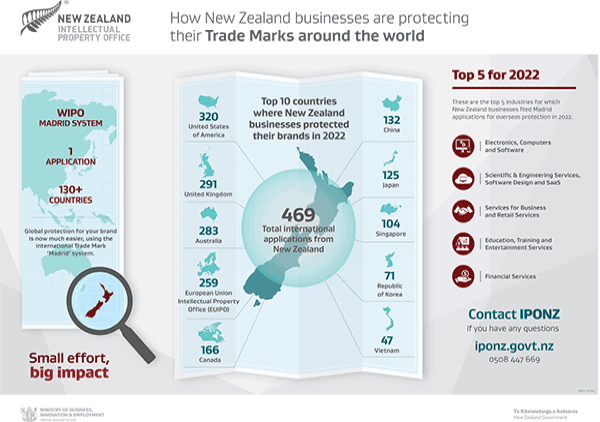
New Zealand businesses constantly protect their trade marks around the world through the 'Madrid' system. In 2022, a total of 469 international applications were filed from New Zealand.
Top 10 countries where New Zealand businesses protected their brands in 2022
- United States of America (320)
- United Kingdom (291)
- Australia (283)
- European Union Intellectual Property Office (EUIPO) (259)
- Canada (166)
- China (132)
- Japan (125)
- Singapore (104)
- Republic of Korea (71)
- Vietnam (47)
Top 5 industries for which New Zealand businesses filed Madrid applications for overseas protection in 2022
- Electronics, computers and software
- Scientific and engineering services, software design and SaaS
- Services for business and retail services
- Education, training and entertainment services
- Financial services
New Zealand 'Madrid' system Trade Marks for previous years
- How businesses protected their trade marks around the world in 2021 [PDF, 1.4 MB]
- How businesses protected their Trade Marks around the world in 2020 [PDF, 852 KB]
- How businesses protected their Trade Marks around the world in 2019 [PDF, 774 KB]
- How businesses protected their Trade Marks around the world in 2018 [PDF, 669 KB]
- How businesses protected their Trade Marks around the world in 2017 [PDF, 589 KB]
- How businesses protected their Trade Marks around the world in 2016 [PDF, 623 KB]
- How businesses protected their Trade Marks around the world in 2015 [PDF, 691 KB]
- How businesses protected their Trade Marks around the world in 2014 [PDF, 1.6 MB]
- How businesses protected their Trade Marks around the world in 2013 [PDF, 4.5 MB]
Filing from New Zealand
You can use your New Zealand application as the base for your international trade mark application. This is known as a New Zealand Office of Origin (NZOO) trade mark.
If you already have an international registration, and want to add more countries, you'll need to submit your request through WIPO directly.
Prepare to apply
Before you start filling out the international application form, make sure the details of the basic mark and its owner are in order.
See Prepare to apply for New Zealand Office of Origin trade marks.
Apply for an international trade mark
Once you've confirmed that the basic mark is suitable, you can apply for an international trade mark.
Apply for an international trade mark.
Filing into New Zealand
It's possible to designate New Zealand in an international application originating overseas. This is called an international registration designating New Zealand (or NZD).
International registration designating New Zealand
Maintain an international registration designating NZ
Some maintenance of international registrations designating New Zealand (NZDs) is done with us, and some is done directly with WIPO.